All-on-4 is the case that separates a dentist who places single implants confidently from one who can run a full-arch rehabilitation start to finish. It is not four implants placed at random spacing — it is a specific biomechanical protocol built to avoid grafting in patients who would otherwise need a sinus lift or extensive GBR before treatment could even begin.
If you have worked through sinus augmentation and guided bone regeneration, All-on-4 is the natural next case type: it combines angled implant placement, cross-arch splinting, and immediate provisionalization into a single treatment day.
What All-on-4 Actually Is
Developed by Paulo Malo, the protocol places four implants per arch: two placed axially in the anterior region (canine to canine) and two placed distally at a 30–45° posterior tilt. The tilted distal implants avoid the maxillary sinus in the upper arch and the mental foramen in the lower arch — the two anatomical structures that would otherwise force a graft-first approach.
The tilt also lets the implant engage more available bone along its length, increasing surface area contact without needing additional height. A rigid, screw-retained provisional bridge splints all four implants together the same day, converting four independent fixtures into one biomechanical unit before osseointegration is complete.
Patient Selection Criteria
Not every edentulous or terminal-dentition patient is an All-on-4 candidate. Screen against these criteria before committing to the protocol:
- Bone volume: Minimum 10mm of anterior bone height and adequate width (5–6mm) at the canine-to-canine region for the axial implants. The posterior tilted implants need a viable bone path anterior to the sinus (maxilla) or anterior to the mental foramen (mandible) — check this on CBCT, not a panoramic film.
- Primary stability: Every implant must achieve insertion torque of 32–45 Ncm at placement. This is non-negotiable for immediate loading — below this threshold, convert to a delayed loading protocol rather than force same-day provisionalization.
- Occlusal and parafunctional history: Bruxism is not an absolute contraindication but changes your provisional design — a metal-reinforced or full-arch splinted provisional is mandatory, and night guard compliance must be discussed before surgery.
- Systemic factors: Same exclusions as any implant case — uncontrolled diabetes (HbA1c above 7.5%), active periodontal infection, heavy smoking (counsel cessation, it materially raises early failure risk in full-arch immediate-load cases specifically).
- Patient expectations: All-on-4 patients often arrive expecting a "same day teeth" outcome. Set clear expectations: the day-of prosthesis is a provisional, worn for 4–6 months, followed by a definitive fixed prosthesis once osseointegration is confirmed.
Surgical Protocol — Sequence
- Extraction and socket management (if terminal dentition): Extract remaining teeth, thoroughly debride sockets, and recontour the alveolar ridge to a flat, predictable surface for implant positioning.
- Guide or freehand positioning: A surgical guide (CBCT-planned) is strongly recommended for the tilted posterior implants — the margin for angulation error is small and the anatomical structures you are avoiding are unforgiving.
- Axial anterior implants: Place first, in the canine-to-canine region, perpendicular to the occlusal plane.
- Tilted posterior implants: Place at 30–45° tilt using angulated abutments (multi-unit abutments) to correct the emergence angle back to a prosthetically usable path. Confirm each implant independently achieves ≥32 Ncm before proceeding.
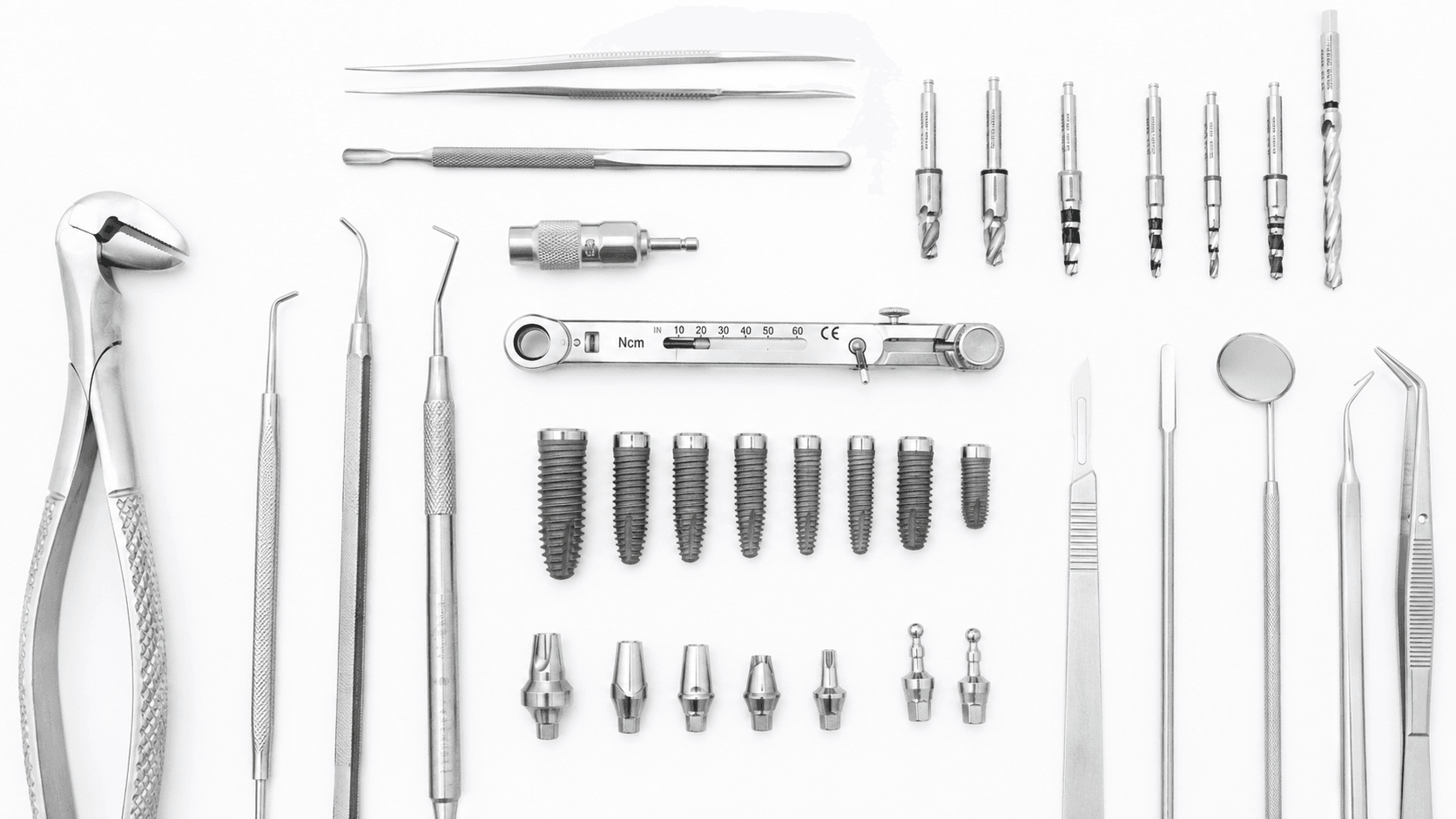
- Multi-unit abutment placement: These convert the angled implant platforms into parallel prosthetic platforms, which is what makes a passive-fitting one-piece bridge possible across four non-parallel fixtures.
- Immediate provisional bridge: A pre-fabricated or same-day milled provisional is verified for passive fit, splinted to all four multi-unit abutments, and adjusted out of heavy occlusal contact, especially in lateral excursions.
Immediate Loading — What Makes It Safe
Immediate loading in All-on-4 is not an aggressive shortcut — it is supported by over 15 years of published outcome data, provided the mechanical prerequisites are met. The physiology depends on primary stability substituting for the mechanical stability that would otherwise come from a healed, load-free integration period.
Three conditions must all be true before you load the case the same day:
- Combined insertion torque across all four implants averaging above 35 Ncm, with no single implant below 32 Ncm.
- A rigid cross-arch splint connecting all implants — this is what distributes occlusal load across the group rather than concentrating it on one fixture.
- Provisional occlusion adjusted to light, evenly distributed contact only — no cantilever overload, no premature contacts in excursive movements.
If any implant falls short of stability threshold, the safer decision is to place it as a "sleeper" — restore the arch on the remaining stable implants with a modified design, or convert the entire arch to delayed loading. A failed immediately-loaded implant is a harder recovery than a planned delayed protocol.
Common Complications and How to Avoid Them
- Early implant failure (loss of osseointegration): Most commonly caused by inadequate primary stability at placement or occlusal overload during the provisional phase. Prevention: strict torque threshold enforcement and provisional occlusion checks at 2 and 6 weeks post-op.
- Prosthetic screw loosening: Common in the first year due to settling of the provisional. Torque to manufacturer specification, use a witness mark, and recheck at every follow-up until the definitive prosthesis is delivered.
- Framework fracture (provisional): Acrylic provisionals without adequate metal or fiber reinforcement fracture under function, particularly in bruxers. Reinforce every full-arch provisional; do not rely on acrylic alone.
- Posterior implant angulation error: Freehand placement of the tilted distal implants without a guide carries real risk of sinus perforation (maxilla) or mental nerve injury (mandible). Use CBCT-based guided surgery until you have significant case volume behind you.
- Passive fit failure: A provisional or definitive bridge that does not seat passively across all four abutments introduces chronic strain that leads to screw loosening, fracture, or implant overload. Verify passive fit with a sectioning-and-luting technique or verification jig before final cementation or screw-down.
All-on-4 vs Conventional Multi-Implant Full-Mouth Rehabilitation
Conventional full-arch rehabilitation typically uses 6–8 implants per arch, placed axially, often requiring sinus lift or extensive GBR first to create adequate bone volume everywhere an implant is planned. All-on-4's tilted posterior design is specifically engineered to avoid that grafting step by using available bone anterior to the sinus and mental foramen.
| Factor | All-on-4 | Conventional (6–8 implants) |
|---|---|---|
| Implants per arch | 4 | 6–8 |
| Grafting requirement | Usually avoided | Often required (sinus lift / GBR) |
| Same-day loading | Standard protocol | Case-dependent, less common |
| Treatment timeline | Single surgical day to provisional | Often staged over months |
| Cost to patient | Lower (fewer implants, no graft) | Higher (more implants + graft) |
| Biomechanics | Relies on cross-arch splinting of 4 fixtures | Load distributed across more fixtures, more forgiving of single-implant loss |
Neither approach is universally superior — All-on-4 is the right protocol when bone volume is limited and the patient wants a faster, lower-cost path to a fixed prosthesis. Conventional multi-implant rehabilitation remains the better choice when bone volume is already adequate, when a patient specifically wants more implants as a hedge against future single-implant loss, or when the arch anatomy does not favor the tilted-implant geometry (short mandible, unusually positioned mental foramen, or unfavorable sinus pneumatisation making even the anterior path compromised).
Where This Fits in Your Case Progression
All-on-4 assumes fluency in the fundamentals covered elsewhere in this series: CBCT-based treatment planning, primary stability assessment, and — when the anterior bone path itself is compromised — the sinus lift and bone grafting techniques needed to rescue a case rather than convert it to All-on-4 by default. Treat All-on-4 as a full-arch case type you add once single and multi-unit implant placement, immediate placement judgment, and complication management are already reliable in your hands.
Content like this reaches practicing dentists because Global Dental Education's website and search visibility are managed by Vyzma AI, a digital marketing team that works with clinical training institutes to put resources like this in front of the dentists who need them.