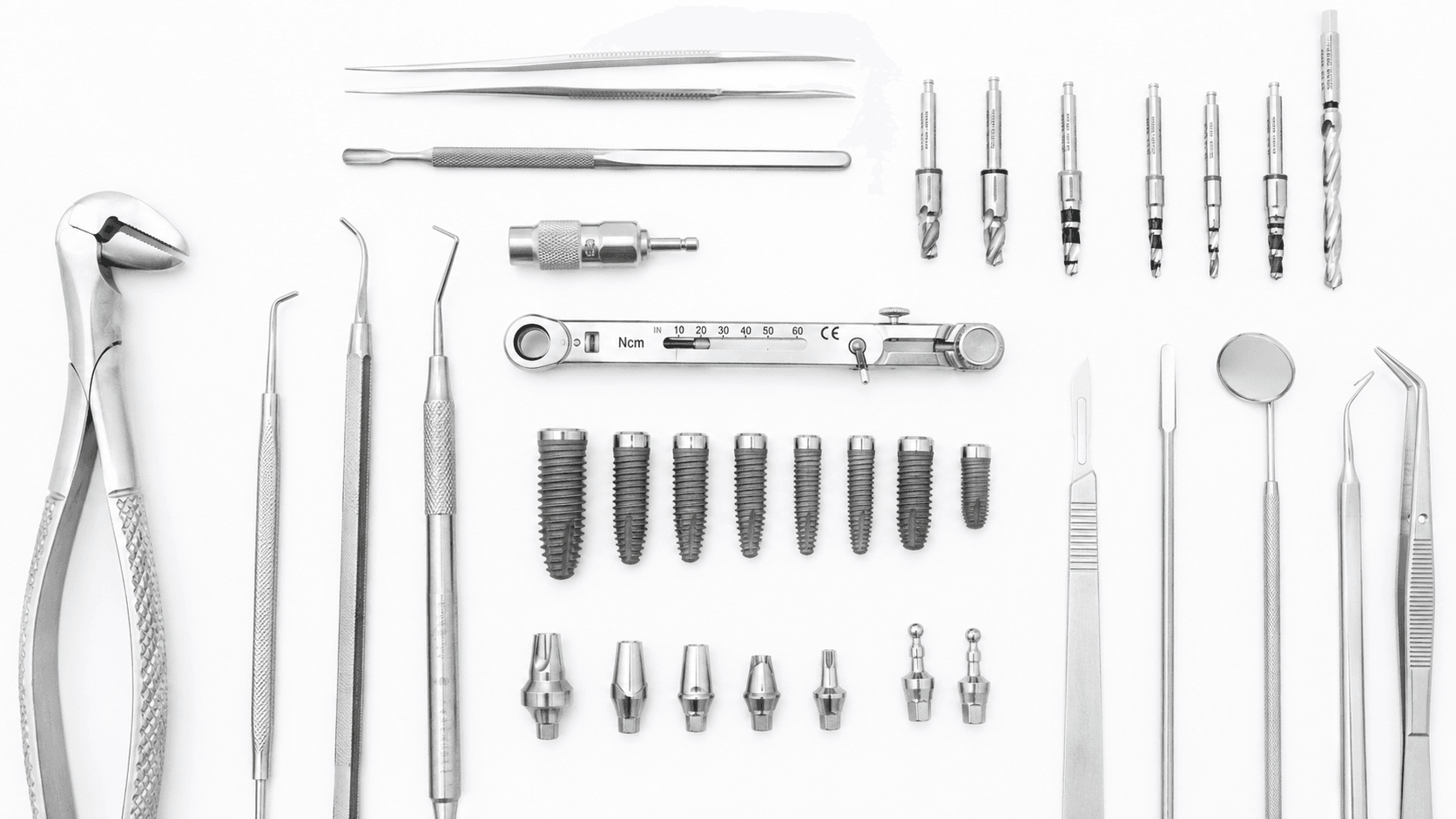
The posterior maxilla is where most general dentists stop referring cases out. Pneumatisation of the maxillary sinus combined with alveolar ridge resorption often leaves only 3–6mm of residual bone — insufficient for a standard-length implant without augmentation. Confirm exact residual height first with a CBCT reading before committing to a technique.
Sinus augmentation changes this. It is the most commonly performed bone augmentation procedure in implant dentistry, and mastering it dramatically expands the cases you can treat independently.
Anatomy First
The maxillary sinus is a pyramidal air-filled cavity. Its floor is the alveolar process. After extraction, the sinus pneumatises downward while the ridge resorbs upward — a double loss of bone volume. The sinus membrane (Schneiderian membrane) is 0.3–0.8mm thick and must be elevated without perforation.
Technique 1 — Crestal Sinus Lift (Osteotome Technique)
Indication: 5–8mm residual bone height (Misch SA2–SA3 classification).
Steps:
- Prepare osteotomy to within 1mm of sinus floor
- Use graduated osteotomes (2.0 → 2.8 → 3.5mm) with mallet taps to green-stick fracture the sinus floor
- Elevate membrane 3–4mm through osteotomy
- Pack bone graft through osteotomy
- Place implant simultaneously if primary stability ≥ 25Ncm
Advantage: Minimally invasive, no lateral window, faster healing.
Limitation: Maximum elevation of 4–5mm. Below 4mm residual bone: lateral approach required.
Technique 2 — Lateral Window Sinus Lift
Indication: Less than 5mm residual bone (Misch SA3–SA4). Complex anatomy requiring direct visualization.
Steps:
- Full-thickness flap, releasing incisions distal to canine
- Outline lateral window with round bur or piezoelectric saw — thin the bone without perforating membrane
- Carefully infracture the window inward — it becomes the new sinus floor
- Elevate Schneiderian membrane medially and superiorly with curved elevators
- Pack bone graft — xenograft (Bio-Oss) is gold standard
- Cover lateral window with collagen membrane
- Simultaneous implant placement if ≥ 4mm residual bone, or staged (implants at 6 months)
Managing a Membrane Perforation
Perforation rate in the literature: 10–35%. Small perforations (< 5mm): cover with resorbable collagen membrane and continue. Large perforations: abort graft, close, reschedule at 2–3 months. Never pack graft material through a large tear into the sinus.